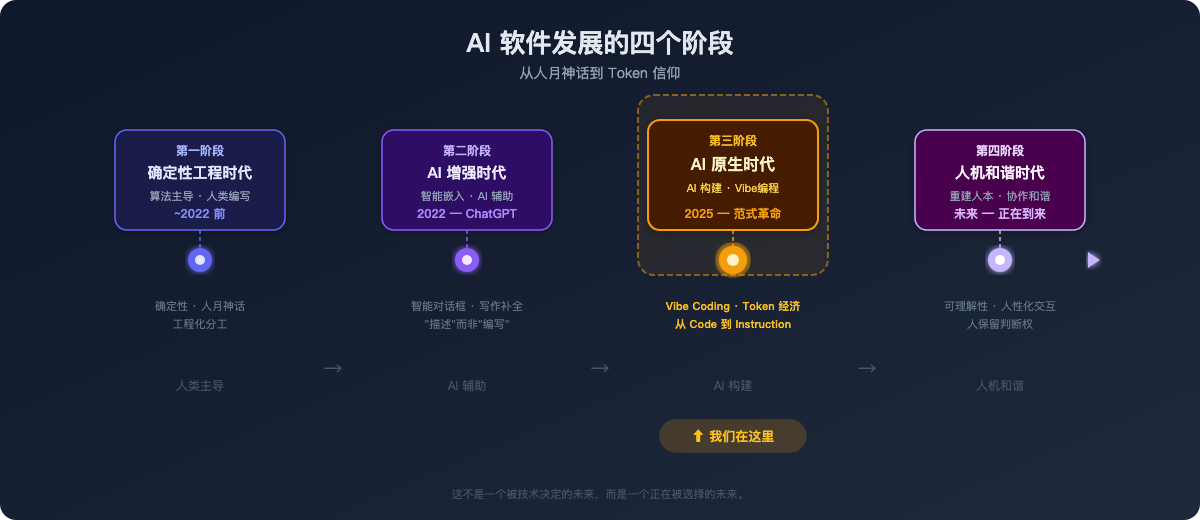
Introduction: A Revolution in Progress
Over the past few years, the way software is built has undergone a fundamental shift.
In 2020, developing a fully functional software system typically required a team of 3–5 people and several months. By 2025, a system of comparable complexity can be prototyped — or even shipped — by a single person with AI assistance, in a single day.
This is not a linear improvement in efficiency. It is a paradigm shift.
This article attempts to trace the inner logic of this transformation: the evolution of AI software is not a single mutation, but a progression through distinct stages — each redefining the relationship between humans and software.
Stage 1: The Deterministic Engineering Era — An Algorithm-Driven Software World
Before AI’s large-scale involvement, software engineering rested on a core premise: system behavior is deterministic.
Engineering Division of Labor
Traditional software development had a clear division of roles: product managers defined requirements, architects designed systems, programmers implemented logic, and QA engineers verified behavior. The underlying assumption was that software development is a predictable engineering activity. Given clear requirements and sound design, output could be roughly estimated.
Deterministic Algorithmic Logic
System behavior was almost entirely defined by code (not models): the same input invariably produced the same output. This determinism formed the foundation of software reliability and shaped decades of engineering methodology.
Boundaries That Could Not Be Ignored
But determinism also imposed structural limitations:
- Knowledge Conversion Bottleneck Vast amounts of tacit expertise (a doctor’s judgment, a lawyer’s intuition) were difficult to encode as rules.
- Linear Scaling Dilemma Human effort and output scaled roughly linearly. The collaboration overhead revealed in The Mythical Man-Month became a long-term constraint.
- Excessively Long Innovation Cycles Going from idea to implementation often took weeks or months. Many creative ideas were abandoned in the face of implementation costs.
This paradigm persisted for decades, until it was truly disrupted in late 2022.

Stage 2: The AI-Augmented Era — Sprinkling “Dust of Intelligence” into Systems
In November 2022, ChatGPT was released. The surface-level explosion was in user adoption; the real change happened in developer mindset.
Incremental Integration, Not Reconstruction
The defining characteristic of this stage was: AI was embedded as an enhancement module within existing systems. Customer service systems gained intelligent Q&A, editors gained writing assistance and code completion, search engines introduced conversational interfaces…
The most symbolic manifestation was those “AI chat boxes” appearing in the corners of interfaces.
AI was still a tool here: it accelerated workflows but didn’t dictate architecture; it assisted decisions but bore no responsibility.
Traditional software engineering methodologies still held — efficiency was simply amplified. But an important shift had already occurred: For the first time, developers realized that software could perhaps be “described” into existence, not just “written.”
Stage 3: The AI-Native Era — From Coding to Vibing
2024–2025 marked the critical inflection point.
A series of events rapidly shaped the new paradigm:
- Large models matched or exceeded human engineers on complex programming tasks
- AI-native editors saw widespread adoption
- AI began covering the full engineering pipeline from design to implementation to debugging
The Emergence of AI-Native Systems
A truly AI-native system is not “a system with AI features” — it is a software form where AI participates throughout the entire lifecycle, from conception to implementation to iteration. Models, especially large language models, began serving as the neural hub for planning and orchestration within systems. AI was no longer an assistant — it became the primary builder.
The Leap in Abstraction Levels
The most fundamental change in this stage was the upward shift in development abstraction:
| Dimension | Traditional Development | AI-Native Development |
|---|---|---|
| Developer Input | Precise code | Natural language intent |
| Workflow | Write → Debug | Describe → Review → Iterate |
| System Behavior | Fully deterministic | Partially emergent |
| Core Competency | Coding skill | Guidance, constraint & judgment |
| Primary Bottleneck | Implementation speed | Requirement clarity |
Code was increasingly hidden beneath models and programming tools. Natural language (Vibing) became the new way to develop software.
Expanding Capability Boundaries
The results were self-evident: non-technical people could turn ideas directly into systems, engineers shifted from “writing code” to “designing system boundaries,” and innovation cycles shrank from weeks to hours.
“Any system can be rewritten by AI” was no longer rhetoric — it became daily practice.
Meanwhile, a new phenomenon emerged: engineers no longer discussed how many lines of code they had written, but how many tokens they had consumed.
Next Stage: The Human-AI Harmony Era — Sprinkling “Dust of Humanity” into AI Systems
When AI becomes the primary builder, a more fundamental question arises:
How do we ensure that systems still serve humans, rather than forcing humans to adapt to systems?
This implies a directional shift: From adding AI into software, to rebuilding human-centricity within AI systems.
Core Challenges
1. Comprehensibility
AI-built systems are growing ever more complex, with behavior partly derived from statistical patterns rather than explicit logic. We need new ways for humans to understand, audit, and trust these systems.
2. Humanized Interaction
Current AI interaction remains highly technical: prompts, parameters, model boundaries. Ideally, people shouldn’t need to “learn how to work with AI” — they should collaborate with systems naturally.
The key is not making humans more like machines, but rather: letting AI handle complexity beyond human capacity while humans retain the right of judgment. Between the two, there should be a clear, controllable, and harmonious interface for collaboration.
Conclusion: Where Do We Stand?
Looking back at this trajectory:
- The Deterministic Engineering Era: Human-led
- The AI-Augmented Era: AI-assisted
- The AI-Native Era: AI-built
- The Human-AI Harmony Era: Rebuilding human-centricity
In 2025, we are in the mature phase of Stage 3, while already touching the edge of Stage 4. The direction of technological progress is not unclear, but society’s and humanity’s choices remain open. This is not a future determined by technology — it is a future being chosen.