From GPT-3 Assistant to DeepSeek Consultant, to the Future AI Superman
The emergence of DeepSeek has shaken the world. The world has long suffered from expensive computing power, technological monopolies, and closed-source AI. The arrival of DeepSeek has undoubtedly broken these shackles.
We are equally excited, yet also more confused. For us, the most impactful aspect is not the technology itself, but the firsthand experience of DeepSeek’s “deep thinking” capability. The R1 model’s confident, unhurried, and organized reasoning ability. This not only means we no longer need tedious prompt engineering to guide AI in logical deduction, but more importantly, AI can deeply understand user intent and provide rich, well-structured answers. This breakthrough elevates AI from its former role as an “Assistant” to a “Senior Consultant,” whose knowledge, thinking ability, and even accumulated experience have already surpassed humanity.
It is foreseeable that AI development will not stop here. After consultants, will it evolve into “Superman”?
With these questions, we asked DeepSeek about the relationship between AI and humanity. After 18 seconds of deep thinking, it generated a fascinating article. Although the extensive references and ornate writing of generative AI no longer feel so fresh, one sentence caught our eye: “Standing at the threshold of human-machine symbiosis, we need to reconsider the profound meaning of Heidegger’s ‘technology is the revealing of existence.’” Thus, we began researching philosopher Martin Heidegger and his representative work The Question Concerning Technology.

Screenshot: Martin Heidegger
Heidegger: Technology is the Revealing (Reveal) of Existence
In The Question Concerning Technology, Heidegger does not stop at defining technology as simple tools, but delves into the essence of technology. He points out that the core of technology lies in bringing forth truth, making hidden existence manifest. Within this framework, he distinguishes between the characteristics of ancient and modern technology:
-
Ancient Technology: Bringing-Forth in Harmony with Nature
- Ancient technology respects nature, utilizing wind power through windmills and producing crops through farming, serving as a way to “bring forth” truth. It reveals the relationship between humans and nature, representing a form of technology that conforms to nature.
-
Modern Technology: Challenging-Forth
- Modern technology no longer conforms to nature but exerts pressure on it, forcibly extracting resources. It unlocks, transforms, stores, and distributes energy, treating nature as an “inventory” that can be extracted and consumed, turning it into a uniform, controllable “standing-reserve.” For example, factory farming and industrial energy extraction both transform nature into consumable units that satisfy human needs.
-
The Danger of Modern Technology
- Heidegger warns that the true threat of modern technology lies not only in changing the face of nature but also in altering the way humans perceive the world. Under the technological framework, all things are simplified into calculable, storable, and callable “spare parts,” causing humanity to gradually lose its understanding of the world’s origin. This technology-dominated mode of thinking may reduce humans to a link in the technological system, rather than the true subjects of the world.
-
How to Overcome the Danger of Technology
Heidegger believed that if humanity could return to a way of coexisting harmoniously with nature, it might avoid being alienated by modern technology and rediscover the balance between technology and existence. The ancient Greek concepts of techne (craft) and poiesis (creation) are methods for humanity to resolve this danger.
- Techne represents a profound understanding of nature, such as a carpenter working with the grain of wood rather than forcibly reshaping it.
- Poiesis emphasizes creativity, such as a sculptor carving an ordinary stone into a work of art, revealing hidden beauty to the world.
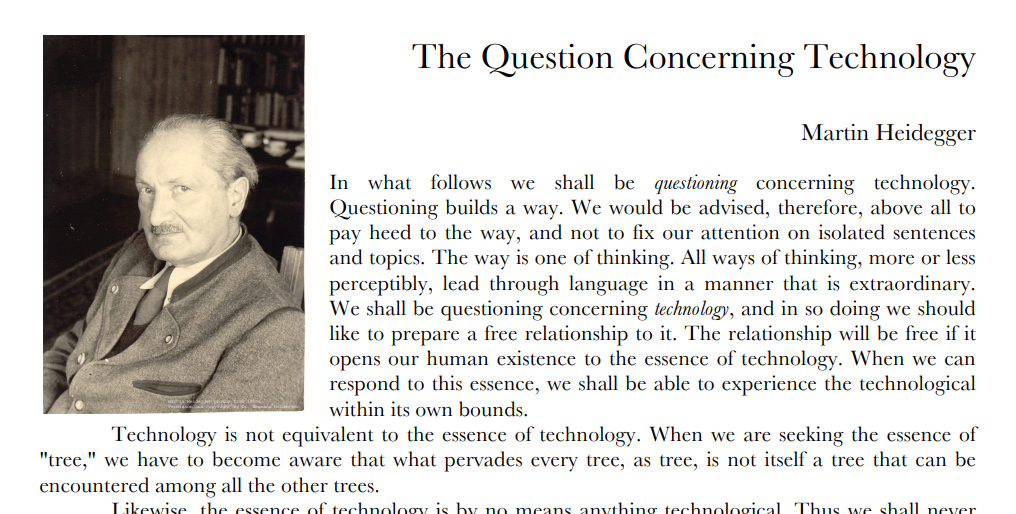
Screenshot: Martin Heidegger’s “The Question Concerning Technology” article
The Essence of AI Technology: The Revealing of Humanity
The Question Concerning Technology was published in 1953. At that time, humanity had recently experienced the nuclear explosions of Hiroshima and Nagasaki, and the shock brought by technology was no less than what we face today with the rapid advancement of AI. People’s fear of technology then bears a resemblance to our concerns about the impact of AI on humanity’s future prospects.
However, AI technology has surpassed what Heidegger described as modern technology. It is not merely the transformation of energy but an intelligent entity capable of knowledge, learning, and reasoning. This transformation means that the risks brought by AI are no longer limited to resource extraction but pose a challenge to human existence itself.
Nevertheless, we can still use Heidegger’s framework, replacing the concept of modern technology with AI technology and the concept of nature with humanity, attempting to deconstruct the essence of AI technology and related issues:
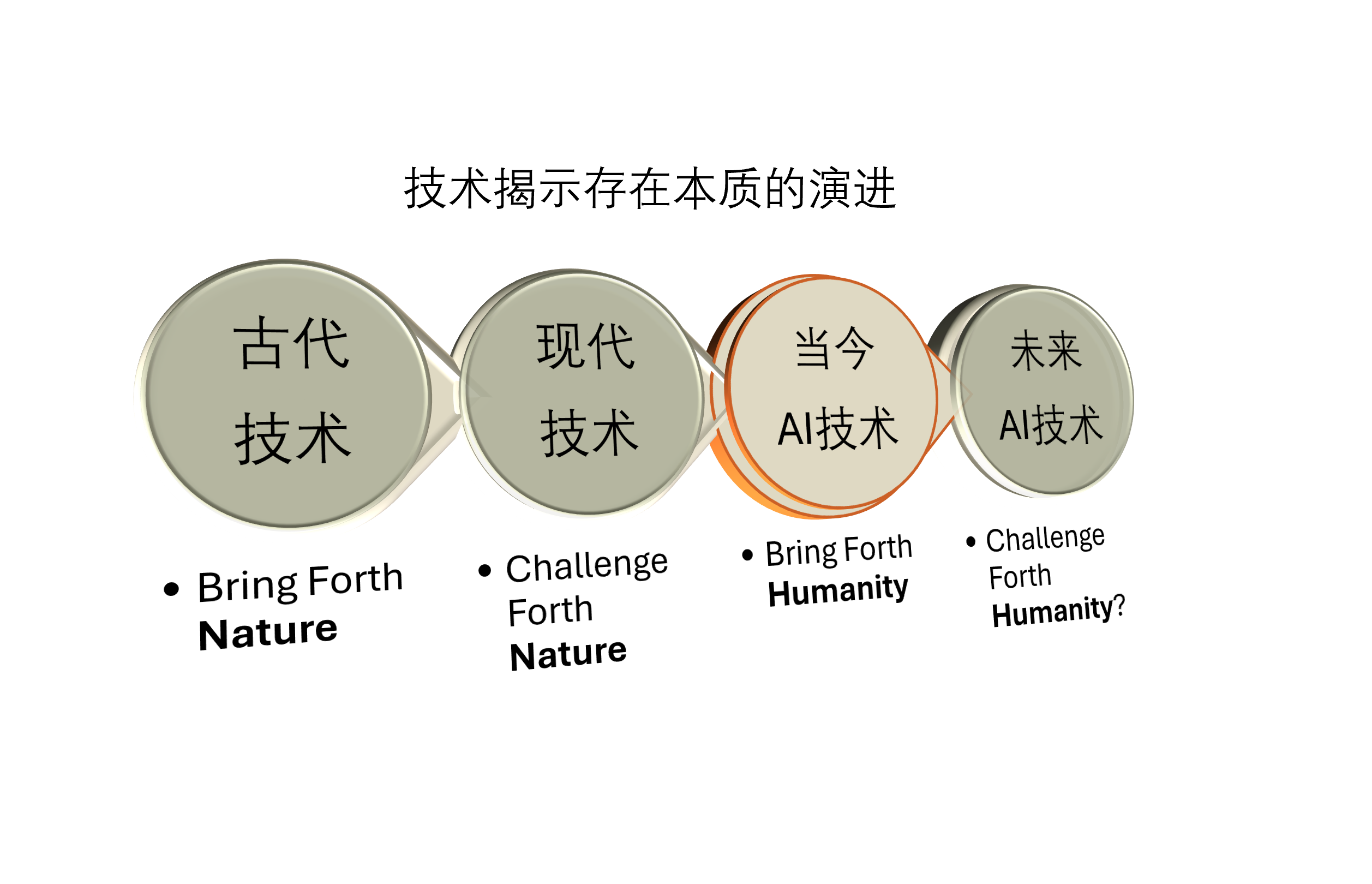
Figure: The development of technology—the essence of its revealing of existence remains unchanged, but the methods have阶段性 characteristics
- Currently, AI technology is the revealing of humanity
- AI at its current stage, such as ChatGPT and DeepSeek, is in the phase of “bringing forth” (Bring Forth) the truth of humanity. It enhances the logic of human thinking and the expression of emotions by learning and simulating human language and behavioral patterns, providing us with a deeper understanding of ourselves.
- A More Dangerous Stage: Challenging the Revealing of Humanity
- In the future, when AI enters the stage of “challenging” (Challenge Forth) the truth of humanity, it will not merely reveal human modes of thinking but will be capable of revealing deeper truths about human nature, thereby possessing the ability to Engineer Humanity. This will give AI stronger judgment and creativity than humans, as well as the ability to autonomously set goals. Will this subvert human subjectivity? Will humans still be able to maintain their dominant position in the world?
- How to Respond to the Challenge of AI Technology
- Returning to humanity may be the key to addressing AI risks. Just as Heidegger advocated for techne and poiesis, we need to create a technical framework that responds to humanity, ensuring that AI development is not merely about optimizing efficiency but centers on promoting human values.
Reflections
AI is not the first technology created by humans that could destroy themselves—atomic bombs have been capable of doing so for a long time. Yet, under the enormous shadow of the world’s end, humanity has survived and rapidly developed for nearly a century. The overall situation is thriving. Therefore, the danger of technology does not stem from technology itself but from how humanity responds to the truth it reveals.
It is not difficult to foresee that AI will bring even greater challenges. Heidegger’s theory cannot answer questions about the future destiny of humanity brought about by the development of AI technology. However, since the essence of AI technology is also the revealing of truth, let us use it to recognize the truth of human nature and apply it to places that highlight the beauty of humanity and make humanity even better.
This article offers a modest contribution to spark further discussion.
Partial Reference Materials:
- https://en.wikipedia.org/wiki/Martin_Heidegger
- Heidegger’s “The Question Concerning Technology,” a lecture. https://www.youtube.com/watch?v=nRp5lzP5L80
- The Question Concerning Technology, the paper. https://www2.hawaii.edu/~freeman/courses/phil394/The%20Question%20Concerning%20Technology.pdf